Blog
What Agriculture Formulators Need to Know About Spray Drift Reduction
September 10, 2026


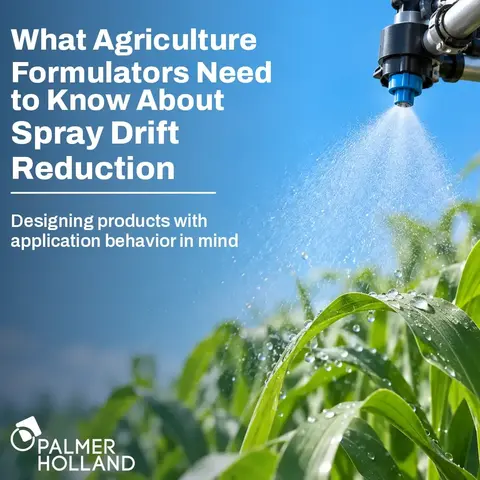
Spray drift itself is not a new challenge. It has been part of agriculture conversations for decades and occurs when pesticide droplets move away from their intended target during or after application, potentially reducing effectiveness and raising environmental concerns.
What has changed is not the amount of drift, but the level of scrutiny surrounding its management. Regulators are placing greater emphasis on application practices and environmental protection, while stewardship expectations continue to rise—particularly around protecting neighboring fields, water sources, and sensitive habitats.
For agriculture manufacturers and formulators, this means drift reduction is now tied more closely to how products are designed—not just something handled in the field.
The Science Behind Spray Drift
Spray drift occurs when some particles land outside the target area during or after application. Several factors influence how and why drift occurs:
- Droplet size: Smaller droplets are more easily carried by air movement and therefore more likely to blow outside the intended area. Larger droplets have more mass and tend to settle more directly onto the target.
- Wind speed and atmospheric conditions: Wind is one of the most direct drivers of drift regardless of droplet size, but temperature, humidity, and atmospheric stability also matter. For example, temperature inversions can carry droplets farther than expected even when wind speeds are low.
- Application height and equipment type: The higher the spray is released above the target, the more time wind and environmental conditions have to influence droplet travel. Nozzle type and spray technology can also affect droplet formation and distribution.
- Formulation and adjuvant effects: The chemistry of a formulation—including surfactants, adjuvants, oils, dispersants, and rheology modifiers—can influence droplet size, spray stability, deposition, and overall spray behavior. These ingredient choices can help support drift mitigation while maintaining application performance.
When these factors are better understood together, it becomes easier to anticipate how products will perform in the field and how they will align with regulatory and label requirements once they reach the market.
How Drift Reduction Requirements Are Evolving
The increased focus on spray drift comes from a combination of EPA regulatory actions, label requirements, and broader drift mitigation frameworks that continue to evolve across the agricultural industry. Rather than a single rule or initiative, it’s a layered set of expectations that collectively shape how products are registered, labeled, and used. For formulators, these evolving expectations increasingly influence decisions made long before a product reaches the field, including ingredient selection and overall formulation strategy.
A major piece of this is ongoing EPA pesticide registration and re-evaluation activity. As part of that process, there is greater emphasis on ensuring product labels clearly outline drift mitigation practices. This can include guidance on droplet size, wind speed limitations, and application height, all aimed at helping reduce off-target movement.
There's also the Endangered Species Act (ESA), which is becoming more present in the background of pesticide decision-making. In practice, that often shows up as buffer zones or location-based restrictions designed to help protect sensitive habitats and species. It can vary by product, but it adds another layer of attention around where and how applications happen.
Ultimately, these regulatory and stewardship expectations are starting to show up in more practical, day-to-day ways. Instead of staying at a high-level guidance stage, they’re built into label instructions and application details that directly shape how a product gets used in the field.
Common Drift Mitigation Requirements You’ll See on Labels
Product labels now include more clearly defined drift mitigation requirements. While the specifics vary by product, there are a few common themes that manufacturers and applicators consistently see:
- Application controls: Labels often include droplet size guidance (typically favoring coarser sprays), wind speed limits, and application height restrictions to help reduce off-target movement during spraying.
- Buffer zones: Many products require set distances from sensitive areas like waterways, residential zones, or protected habitats, with buffer sizes that can vary depending on use conditions.
- Mitigation options: Some labels now allow “stackable” mitigation approaches, where practices like nozzle selection, spray adjustments, or other application choices can be combined to help reduce required buffer distances.
The key takeaway is that drift mitigation is becoming more structured, but also more flexible. Instead of a single instruction, it often functions as a set of options that can be combined depending on conditions.
Drift Reduction Technology and the Role of Application Systems
One of the clearest ways drift reduction shows up in practice is through the Drift Reduction Technology framework. It’s essentially a way to compare how different application tools and choices actually perform when it comes to reducing spray drift in the field. While DRT often focuses more on equipment, formulation also plays an important role in how products behave during application. Together, chemistry and application technology help determine overall drift performance.
What Falls Under DRT Evaluations
This isn’t just one type of product or tool. It typically includes a mix of application equipment and chemistry-based solutions, such as:
- Nozzles and spray tips: Help control droplet size and spray pattern, which directly impacts drift potential
- Spray shields and physical drift reduction tools: Help block wind influence and limit spray movement outside the target zone
- Adjuvants and tank mix additives: Surfactants, oils, dispersants, rheology modifiers, and other functional ingredients can all impact how a spray performs in the field.
Each of these plays a different role, but they all tie back to the same goal: reducing the amount of spray that moves off target.
How Performance Gets Communicated
DRT evaluations are often expressed through a tiered star rating system. These star ratings provide a relative indication of how well a given technology performs in reducing drift compared to standard application setups. While the details of each rating can vary, the intent is to give applicators and manufacturers a shared reference point when evaluating options.
Where Formulation Strategy Meets Application Reality
With drift considerations moving earlier in development, formulation strategy and application reality are becoming more closely linked. Formulators are increasingly evaluating how ingredients influence application performance, including:
- spray droplet formation and stability
- deposition on the target surface
- compatibility with modern application equipment
- balancing biological efficacy with drift mitigation goals
At the same time, innovation is occurring more often at the intersection of chemistry and application technology rather than in isolation.
At this stage, ingredient expertise becomes especially important. Connecting formulation goals with functional ingredient choices—and understanding how those choices translate under real-world conditions—is now a key part of supporting product development.
Designing Products with Drift in Mind
Drift reduction is now built into how agricultural products are developed, labeled, and used. For manufacturers, that means thinking about application behavior (like droplet formation and spray conditions) earlier in the formulation process, not just at the point of use.
As drift mitigation expectations become more integrated into product development and registration strategies, there is also growing focus on how ingredient selection impacts both application performance and alignment with regulatory requirements.
This is where Palmer Holland can help. We partner with formulators to connect ingredient selection with formulation performance, application behavior, and evolving regulatory practices. By bringing together technical expertise, supplier partnerships, and a broad portfolio of specialty ingredients, we help simplify complex formulation decisions.
Connect with our team to learn how the right ingredient selection can support your next formulation.
This article is intended for general informational purposes only. Applicators and manufacturers should always refer to approved product labels and the latest EPA (and PMRA, where applicable) guidance when making formulation or application decisions.